My first role in education was working as a Class Teacher in a small Waldorf school in rural south-west Wales, UK. My knowledge of Waldorf education is very much grounded in my more than 10 years of teaching experience there – working with children aged 6 to 14 – and the training I received for that role and as the school’s Additional Learning Needs Coordinator.
I offer here an introductory overview of Waldorf education. I will over time expand on this through my writing in the Research and Reflections section of this website and share with you the voices of others, including Rudolf Steiner, who have contributed to the body of theory and practice that today is known as Waldorf education.
In my writing below, I use the term ‘Waldorf’ to refer to the educational philosophy, which is commonly also referred to as ‘Steiner’ education, or ‘Steiner-Waldorf’ education.
Child Development
Waldorf education is centred on child development, with children understood to pass through particular phases of development between birth and adulthood, and education intended to purposefully meet each child within this process, enabling them to achieve the fullness of their human potential. It is based on the work and understanding of Rudolf Steiner (1865-1925), an Austrian philosopher and social reformer who characterised human beings as comprising not only a physical body, but also a soul and spirit. These terms, which Steiner used within his spiritual philosophy, Anthroposophy, do not directly equate with the understandings presented by the Abrahamic faiths; nor do their use by Steiner reflect any notion of Waldorf education, or Waldorf schools being in any way religious. Rather, the use of terms such as soul and spirit point to human beings possessing not only a material existence, but an inner life as well.
Three Phases of Childhood
Childhood, understood by Steiner to progress from birth until age 21 (though Waldorf schools do not operate beyond age 18), is separated within the Waldorf educational philosophy into three phases, each seven years long. The first phase, running from birth until age 7, is a time of physical development during which children learn primarily through imitation of the adults and other children around them. The second – from age 7 until 14 – is a time of development of the imagination; children learn best through artistic expression, storytelling and practical activity during this period, with the intellect beginning to emerge during the latter half of it. Finally, between 14 and 21, the intellect emerges more strongly and independent thinking, a sense of justice and a desire to understand the world all become important.


Thinking, Feeling and Willing
These three periods then are reflective of the forces that work within children, encapsulated by Steiner in his threefold understanding of the nature of the human being: thinking, feeling and willing. Whilst from one point of view, willing is related to the first period of childhood, feeling to the second and thinking to the third, human beings embody a complex interaction of all three, which need to develop in a balanced way during childhood to ensure a healthy, well-rounded life. The importance of the three being in balance is perhaps best represented in Waldorf education by the commonly used expression: Head, Heart and Hands, whereby there is an understanding that children need to learn holistically, through their whole being, and lessons are tailored to touch each aspect of their threefold nature.
The Teacher
Teachers in Waldorf schools must be grounded not only in a good understanding of child development, and the threefold nature of the human being, but also be able to recognise the needs of each and every individual in their care on a personal level – to ensure that each child is able to reach the fullness of their human potential: emotionally, academically, physically and more. For the teacher, this necessitates the capacity to be self-reflective and self-reflexive, to ensure that they can cultivate a meaningful connection and relationship with each child. This also entails that teachers develop their skills of observation – both individually and collectively – and use those to reflect upon each child as a whole so that they can work to address what Steiner referred to as the child’s obstacles and hindrances that prevent each one from realising their potential.
The Curriculum
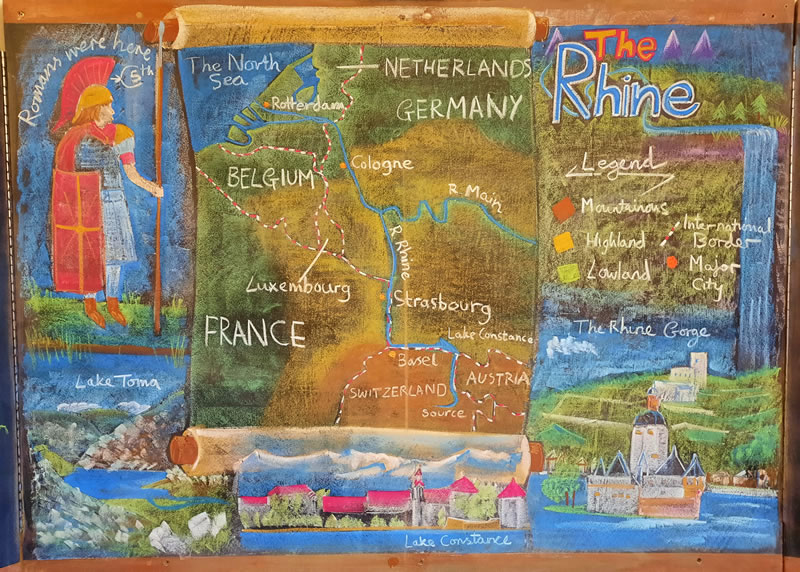
Furthermore, teachers are given the freedom to employ the curriculum with a significant degree of creativity and flexibility to ensure that they can truly support their students both collectively and individually. This means that whilst there is a clear and definitive curriculum, created over time to meet students’ needs wherever they are on their journey through childhood, it is entirely common for teachers to bring different ideas, content and activities in their teaching. Being conscious of the needs of the children in one’s care, and undertaking a meaningfully creative approach to meeting children in their human development are key elements of a Waldorf education. Indeed, it is both this creativity within Waldorf teaching, and the focus on engaging each child in their whole being, that leads to Waldorf education often being called: the Art of Education.
Discover more