In this, the third interview in my ‘Voices’ series, Mark Foley reflects on more than two decades of supporting his friend and teacher Lobsang Phuntsok and Jhamtse Gatsal Children’s Community in Arunachal Pradesh, India.
Mark is the President and Executive Director of Jhamtse International, an American non-profit organisation based in Concord, Massachusetts, that supports Jhamtse Gatsal through fundraising and raising awareness.
We’ve shared many conversations over the years, and in particular last year when I was privileged to travel with him as part of a group spending time with the Community in the foothills of the Himalayas.
It’s an immense pleasure to share our most recent conversation in which we spoke about how Mark first came to meet Lobsang, what Jhamtse Gatsal truly means, and how Lobsang’s focus is now shifting towards a global audience, highlighted by the recent release of ‘Loving Karma’: a new film about the Community.
A Monk in Concord
“We all have within us the seeds of compassion to heal ourselves and the world around us. With right-nurturance and right-environment, these seeds will take root and flourish within us.” – Lobsang Phuntsok1
When Mark met Lobsang Phuntsok in 2001, his experience of mindfulness practice was limited; he had dabbled in Transcendental Meditation in his college years on the back of an Irish Catholic upbringing, but whilst he maintained a lingering interest in mindfulness, it had not yet blossomed into anything more.
Two events changed that. The first was that Mark read a book: ‘The Zen of Listening: Mindful Communication in the Age of Distraction’ by Rebecca Shafir.
“It was all about how to be mindful and present to be a really good listener. And the book was really beautiful. Now she was a practitioner and so there was a lot of quieting the mind and a ‘Zenful’ way to be with someone, and to really truly listen to what they’re saying and not trying to think of a response but really, really listening. And so that got me curious about Zen.”
At this time, Mark was working in marketing; the book had pricked his interest with a view to improving his ability to listen to clients. Yet there was also something deeper at work, connecting back perhaps to an inner sense that life had greater meaning than he had once believed.
The second event would enable Mark to bridge that connection.
“And then at the time I was reading the book, there was a story in the Boston Globe about this young Buddhist monk living in Concord, Massachusetts, giving teachings, which is the next town over from me, and I’m reading this book going: ‘Wow!’
“And here I read an article about this Tibetan Buddhist monk, and I went over the following Thursday night. It was literally the first time I sat there. I can visualize right now in my head where I was sitting, second to last row, up against the wall.
“It was a cold night and a warm room. So I’m just settling in and I just thought: ‘Man, what is this going to be like?’ And he’s up there doing his thing, and halfway through, honest to God, something like opened or awakened or whatever you want to call it. I don’t know; I don’t want to say it was mystical, but honestly, I heard my true inner voice.
“It wasn’t a thought, but I literally heard some inner voice of real depth saying to me: ‘These words he’s speaking are like the absolute truth. You know, this is the absolute truth of life.’ And it was so powerful because already in these simple words, it was like an expansion in my mind of what life could be.
“Up until that point, 40 years old, I was living the American dream. You go to college, you get married, you have children, you work, work, work. You have, you have stuff. It was pretty narrow, right? A pretty narrow mind view, and 35 minutes into listening to him something popped, but big time popped. It was unbelievable.
“And I said to myself right then in my deepest conscience, I said: ‘You have got to stick with this for as long as you can, just to learn more and be more.’”
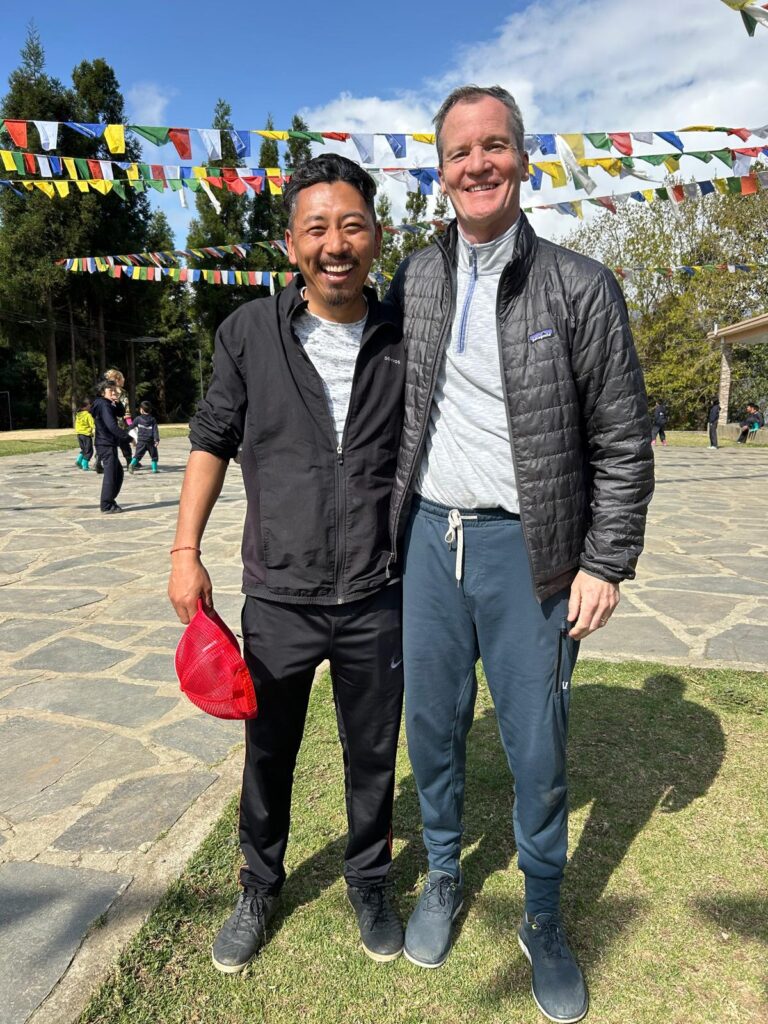
The Anchor of their Life
Lobsang, or Genla as he is respectfully known by his students and members of the Community, had arrived in the United States in 2000, having been invited by a Rinpoche (a Tibetan teacher) from Sera Jay Monastery in India to translate for him at the UN Millennium Peace Conference in New York in the same year.2
In the late 1990s, he’d been selected by His Holiness the Dalai Lama, for his excellent capacity with languages, to undertake a two-year training programme in India with the intention that he would then travel to the West to teach Buddhism.
Whilst in New York, he travelled north to the Boston area to visit a friend. This in turn led to an introduction to the First Unitarian Church in Concord where he gave a talk during one of the Sunday sermons, which moved members, and inspired them to ask Lobsang to return.
And he did: between July 2001 and 2008, he taught at the church in Concord.
“So at the time when Lobsang was teaching he would do Wednesday mornings and Thursday nights. Each weekly gathering would be somewhere between 30 and 45 people, which filled up this chapel room.
“This was a small room off the main church where Thoreau and Emerson and all those guys had hung out. He would fill the room up. It was such a diverse group of people.”
Mark’s first impressions of Lobsang “were of warmth, humility, and profound authenticity.” These impressions would only deepen over time as Mark continued to attend the teachings, inspired by what he heard.
“He would talk a lot about mind training. That in meditation you could actually train your mind to slow, you know: how you respond and how you react.”
“But the other thing that was fascinating about this group: after Lobsang would talk, we would come out into the lobby and would put our shoes back on, and no matter who the person was, whether they had been a practitioner for 20 years or someone new like me, or whatever they were dealing with in their life: something at work, something with their spouse, something with the kids, everybody would come out and say: ‘Wow! That was such an amazing teaching. You know, I’ve been struggling with this and I felt like Lobsang was speaking to me and giving me the answer for what I needed to know.’
“And someone else would say something else about a completely different situation: ‘Wow! I felt like Lobsang was speaking to me, and he gave me this insight of how I need to respond.’ And then people who had been deep practitioners for 20 years were like: ‘Oh my gosh, I had never heard it expressed that way.’
“And that gets back to Lobsang as a teacher.
“What makes Lobsang so resonant as a teacher is he keeps everything so simple and so human, and even when he’s teaching about a more nuanced Tibetan Buddhist understanding of something, he talks about his own personal life, and he’ll bring in a personal anecdote which people listen to, and then it makes his teaching so, so, so relatable.
“So it was a really magical time when he was in the United States from 2000 to 2008; it was a magical time.
“So many people, hundreds of people; they would say that they looked forward to this Thursday night. People would say Thursday night was like the anchor of their life.”
You have to Embody the Mission
In 2003, Lobsang asked his American sangha to support a new vision: one that would see a community for children established in his home state of Arunachal Pradesh in north-east India.
Here, a short car ride from Tawang, home to the largest Tibetan Buddhist monastery in India, Lobsang established Jhamtse Gatsal Children’s Community, in the heart of the Monpa ethnic region, an area rich with culture and natural beauty, and yet deeply impoverished. Jhamtse Gatsal – which means Garden of Love and Compassion in Tibetan – offered a heartful nourishment to the children who came to live there.
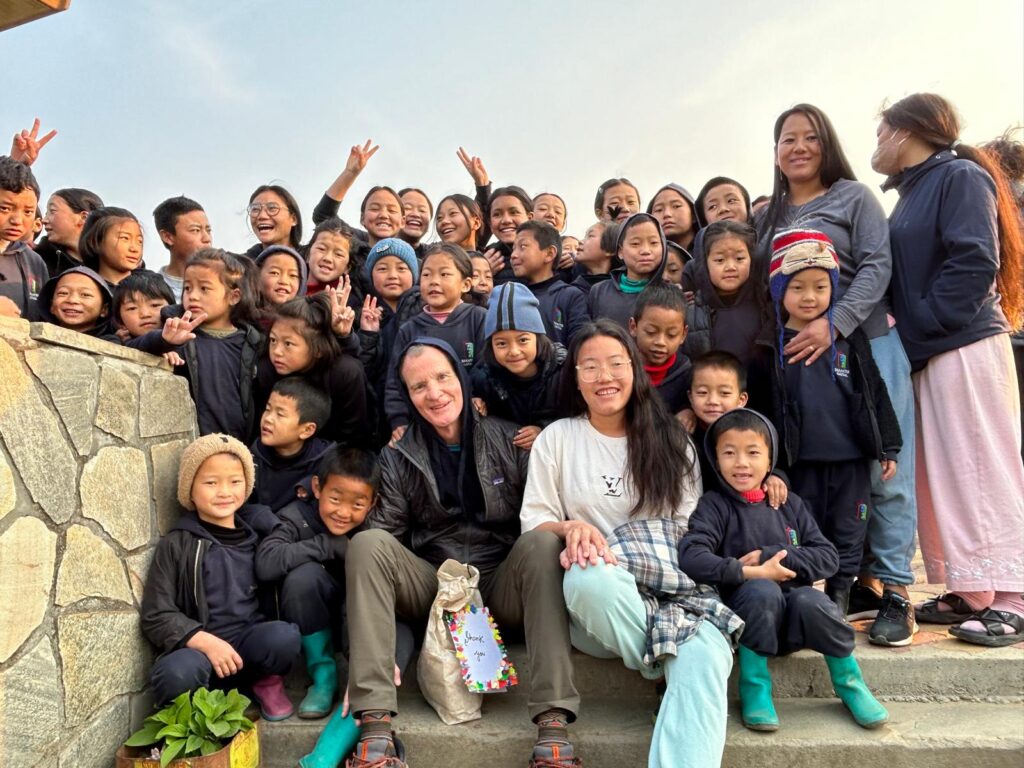
Since 2003, Jhamtse Gatsal has flourished, growing from its original 34 children to now being home to 125 and a multitude of teachers, house mothers, cooks and others.
And Mark too has experienced his own transformation during that period: from a successful career in marketing to becoming the President and Executive Director of Jhamtse International.
I ask him how he came to take on his current role, and what he feels he’s brought with him from his previous career.
“In 2005 when the non-profit started, Lobsang had shared his vision and his dream to start Jhamtse Gatsal and people raised their hands and I said: ‘Sure, I’ll do whatever I can to support you.’
“And one day he said: ‘Would you want to be president?’ And I was like: ‘Yeah, sure.’ I had no idea what it meant. Never done non-profit work, but okay. And I still had a full-time job at that point in software, mostly in business development, working with customers and clients and trying to grow the business.
“And so I was always sort of a relationship guy, trying to meet with people to understand their own challenges and needs, and then support them and their initiatives, and I had a certain philosophy about doing that.
“So in terms of the work I’ve been doing full-time since 2018 as Executive Director, it was a fact that this non-profit, which is still very small, needed to grow.
“So we needed to develop new relationships and meet new people, deepen the relationships with our base of supporters and be able to have conversations with them so they felt more connected to this work. And when it felt right, when the time was right, those that were donating a certain amount each year would be inspired to do more. And when we had needs, we could go to people and ask for more.
“And so, from an Executive Director perspective, the fact that I had this background in developing and growing businesses and working with clients and prospects, and developing those relationships in the right way with a long-term mindset, that was definitely a useful skill set.
“But to be honest, the other reason why this made so much sense was I came to know over my 30 plus year career that I had some jobs where I could be successful and sort of sell or market, but I didn’t believe in what the product was. And I knew that in order to develop relationships with people to represent something, I had to believe in it 100%.
“And so the opportunity to take these business skills, but to do it with something that I’m so passionate about and I believe so deeply in, I knew it was going to be so much fun and so inspiring for me to talk about this work with people and share what I know and what I believe. And so that was the most important thing.
“But, I wanted to answer this a bit more nuanced, and that’s what’s been really interesting for me on this journey, and this goes back to a conversation in 2018 with Lobsang where he was coming up with a new vision and mission statement, and he was saying: ‘I think our mission is to rekindle the human spirit and rebuild the human community.’
“And Vasu3 and I are writing this down. But then he looked at both of us and he said: ‘You know, the most important thing about this mission statement, unlike another business who has a mission statement like Apple, like we’re trying to sell beautiful computers; for us, we have to be the mission. You have to embody the mission.’”
The Ingredients of Jhamtse Gatsal
Mark first visited the Community in Arunachal Pradesh in 2008.
“It was one of the most profound affirmations of the path I had begun,” he explains. There, love and compassion are not simply words, but “the very fabric of daily life.”
Describing itself as ‘a model Community and Learning Center that is inspiring purposeful living on a local, national and global level,’4 Jhamtse Gatsal is “not just a children’s home or a school,” says Mark. “It is a family.”
“The main ingredient is this shared understanding and this shared purpose of what this is all about, such that all of the children and all of the adults all belong to something really, really special and something more powerful than themselves, right?
“So that, to me, that’s like that community, that family, that family sense of belonging. I am a part of this family, and if I’m young I have older brothers and sisters taking care of me. But they also, because of that belongingness, they also grow up with a sense of responsibility and purpose.
“Meaning that even the little ones do their little chores, and they line up the shoes and the bigger ones do more heavy lifting, and do the laundry. And depending upon your capabilities, you do more.
“But I’ve never seen children doing things with so much joy before because I think it comes from that place of: ‘This is what our family does. I belong to this. I have a purpose; my little task is still just as important as that 14-year-old’s task of doing something else.’
“So everybody grows up to feel, you know, special, and they’re a part of this, and all together we’re doing this.”
Loving Karma
The sense that Jhamtse Gatsal Children’s Community is indeed more a family than a home or school for children is clear from Andrew Hinton’s and Johnny Burke’s 2013 documentary ‘Tashi and the Monk’.5
The film, which enjoyed international exposure at film festivals and won an Emmy for Outstanding Short Documentary in 2016, captures the essence of the Community through the beautiful everyday interactions of children and staff, unfolding the story of five year old Tashi, whose troubled upbringing leaves ‘her struggling to find her place amongst 84 new siblings.’6
‘Tashi and the Monk’ shows us that through the profound care of the Jhamtse Community, including Tashi’s new older brother Raju, whose sense of responsibility and love echoes – and perhaps has equally helped to instil – Mark’s own sense of what Jhamtse Gatsal truly is, the young girl is brought on a journey of healing through love and heartful intention.
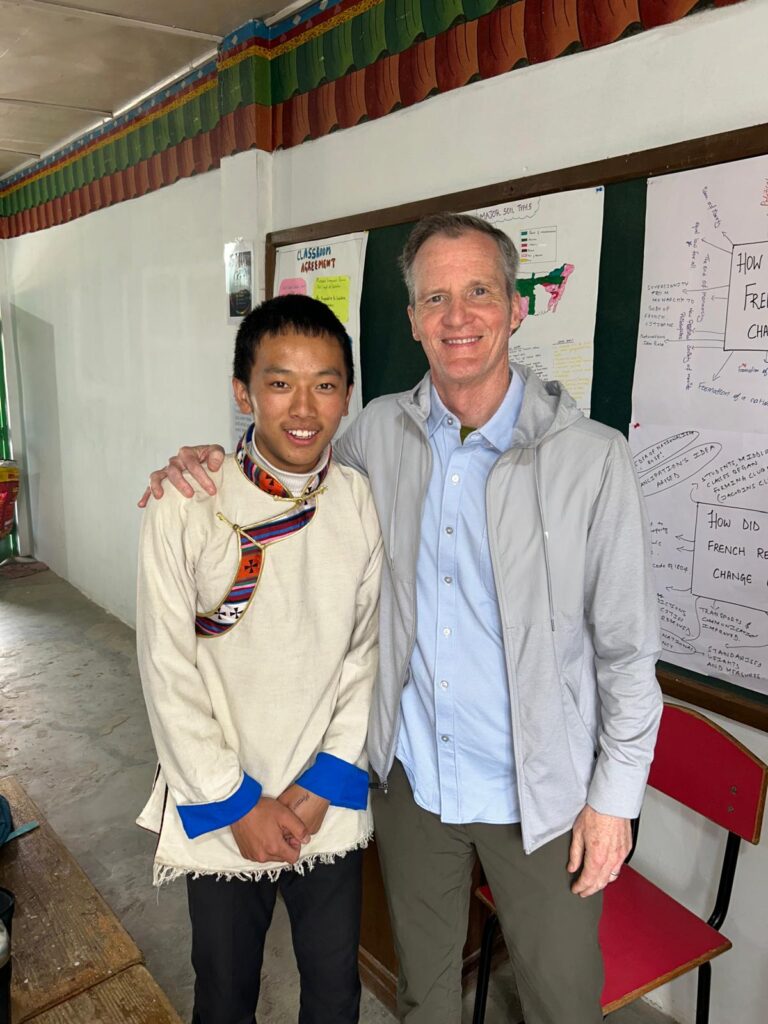
October 2025 sees a new chapter in that story: ‘Loving Karma’, a latest installment by the same filmmakers. For Mark, this signifies a new shift for Lobsang’s and Jhamtse Gatsal’s work, beyond the confines of the Community in India, and onto a more global stage.
The new film, Mark explains, weaves together the original one and a new storyline.
“The filmmakers wanted people who hadn’t seen ‘Tashi and the Monk’ to experience Tashi’s beginning at Jhamtse Gatsal. Then the middle point of the movie has a beautiful scene, the words come up: ‘Twelve years later.’
“Then you see what kind of an adolescent teenager she’s blossoming into, and how she adopts these two young boys who came to the community last summer, both of them named Karma. And she takes on this mothering role.
“But so many other storylines are woven into the continuation of this Jhamtse journey, this healing journey.
“There are scenes in the film when some of the young adults are going off to college; there’s a scene where Raju says: ‘I’m a little excited and anxious about going off to college. I’ve never been in a big city before.’ But Genla always reminds us, all of us, that Jhamtse Gatsal is not a physical location. Jhamtse Gatsal is in all of our hearts. Everybody’s hearts on the planet, and wherever you go, you take Jhamtse Gatsal with you. You take this garden of love and compassion with you. So Raju says: ‘I’m happy to know that I’m bringing Jhamtse Gatsal with me. It’s in my heart and that’s what I’m going to plant when I get to college.’
“And the difference now with this new film and the intentionality behind sharing it, is that the first film kind of really stayed anchored in Jhamtse Gatsal. This ‘Loving Karma’ story is making this Jhamtse journey far more universal and far more global.
“This is a humanity story. This is something that is true for all of us. This is an example of this particular community. So we want to have a more universal global conversation, especially now given what’s happening in the world, and how people are feeling lonely and isolated and not part of a community.
“We’re hoping with this new film we can do some community building. Lobsang wants to be more visible, traveling and speaking, and talking so people can learn about what Jhamtse really means: that inner work of trying to find some inner happiness and contentment so that we can all take care of each other.
“It’s exciting to be a part of it, you know. We’ll see how many hearts we touch, but the goal is to very gently take our time, be mindful, and we’ll see how it goes. We’ll get the ripples going and we’ll see where it goes.”
To watch ‘Tashi and the Monk’, and find out more about Jhamtse Gatsal Children’s Community and ‘Loving Karma’, visit https://jhamtse.org/
- Meet the Founder: Lobsang Phuntsok ↩︎
- Jhamtse Gatsal: Fostering Seeds of Compassion ↩︎
- Vasudha (Vasu) Wanchoo is the Managing Director of Jhamtse Gatsal Children’s Community ↩︎
- Jhamtse Gatsal: Our Work ↩︎
- Tashi and the Monk ↩︎
- Tashi and the Monk ↩︎