In this, the fifth interview in my ‘Voices’ series, Paul Pearson reflects on his journey of faith and career, both of which have been deeply intertwined with the life and writings of the late Thomas Merton, who Pope Francis called one of the four great Americans.1
Paul is the Director of the Thomas Merton Center2 at Bellarmine University in Louisville, Kentucky and Chief of Research for the Merton Legacy Trust. He is Resident Secretary of the International Thomas Merton Society and a founding member of the Thomas Merton Society of Great Britain and Ireland. Paul has edited several books relating to Merton, including, most recently, Beholding Paradise: The Photographs of Thomas Merton.
I have known Paul for over two decades, since I first wrote to him regarding my growing interest in Merton, and he in turn sent me – amongst other things – a recording of the late contemplative speaking to novices at Gethsemani Abbey3 in 1968, so that I could hear his voice and with it both his wisdom and humour.
More than twenty years on, I am grateful to Paul for speaking with me about Merton, and once again opening a window into his life.
A Catholic upbringing
Paul was raised in England, a long way from his current home in Kentucky. Brought up in a Catholic household in Plymouth on the south coast, he attended a Catholic school. It was here in the late 1970s that Paul, aged 15, first encountered the writings of Thomas Merton.
Paul explains: “Once a term, the curate from the local parish used to come in and talk to the kids. And on this day, he talked about Merton’s autobiography.” (The Seven Storey Mountain, published as Elected Silence in England).
“He told us Merton’s story based on that, in 30 minutes or whatever. And I just thought: ‘Wow, that just sounded so fascinating. I want to read that.’”
Paul relates how the book was not in print, and in the 1970s he didn’t have the option of tracking it down on the internet. Instead, he found The Monastic Journey, a collection of essays published after Merton’s death about monasticism and the hermit life.
“Okay, so not quite the usual thing you’d give to a 15-year-old,” Paul explains. “But there was just something in his writing that spoke to me.
“I think it was his search for God; just that kind of yearning there that felt as if it was speaking to something within me, and I wanted to read more of him.”
Though a vocation within the Church was undoubtedly encouraged by the Irish Christian Brothers at school, and Paul’s enthusiastic reading about Catholic monasticism would have likely been welcomed, he was on a different path, one inspired by Merton, and indeed reflective of the Trappist monk’s broad perspective on faith.
“From then on Merton seems to have been a companion to me, and has opened up many other directions in my life.”
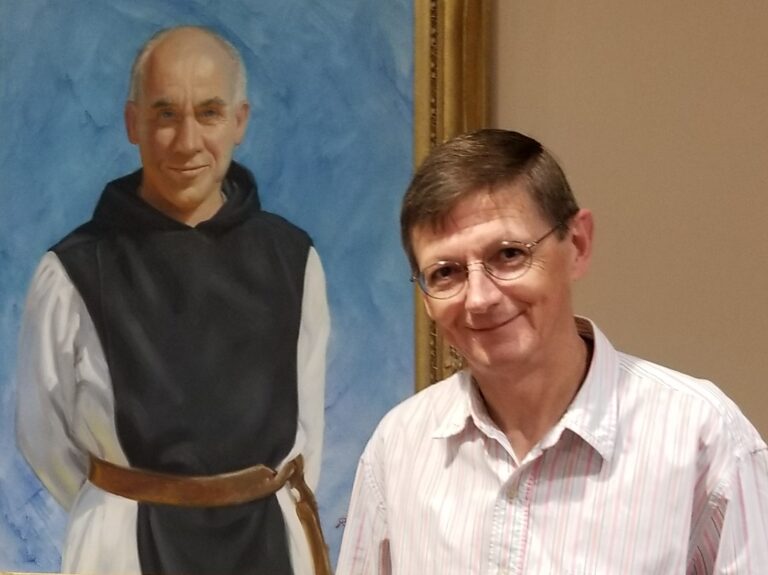
Paul in front of a portrait of Thomas Merton
Who was Thomas Merton?
Thomas Merton was born on the 31st of January 1915 in Prades, France. The son of artists, he joined the Trappist Order of Gethsemani Abbey in Louisville, Kentucky, on the 10th of December 1941, exactly 27 years prior to his death.
Best known for The Seven Storey Mountain, Merton would go on to become a renowned monk, author and poet, both entirely comfortable in his own Catholic faith and equally eager to engage with other religious traditions.
Indeed, His Holiness the Dalai Lama has often spoken about how Merton really introduced him to the true meaning of the teachings of Christianity.4
I ask Paul how he would characterise Merton. “That’s really challenging,” he tells me.
“The people I meet when giving talks all seem to have their own version of him, and I’m sure I probably do in some ways too.
“But I do like to feel that I’ve got a larger picture, having lived with him for so many years, and that I can give people a perspective on Merton that maybe opens up to them some of the other areas that they’ve not really been thinking about.”
Paul begins: “He encompassed everything that was maybe best about the world and Christianity; he embraced humanity.
“He was a monk in a very enclosed monastic community, but he had an embrace of the world that very few other figures that I come across really have, and Merton had a gift for sharing that in his writing.
“And that was quite a journey.” Paul relates how even The Seven Storey Mountain, later somewhat dismissed by Merton as not truly representative of his faith, at least as it was in his later years, portrayed a version of Catholicism very much unlike the experience of the majority of Catholics at the time.
“The narrowness of most people’s Catholicism was quite something in the 1940s and 50s. And so things that Merton was discovering and talking about in The Seven Storey Mountain (first published in 1948) – prayer and contemplation and the discovery of God – this was talking about Catholicism in a way that was very different to most people’s experience of it.
“I just remember the Catholicism of my childhood,” Paul tells me. “Mass being all in Latin and, you know, we would have the family rosary or something at home of an evening. But the idea of a relationship with God and things like meditation and contemplation was still pretty unknown.”
Merton considered the book had not gone far enough; it was an early step on a journey to more deeply embracing the world beyond his cloistered life. Nonetheless, Paul explains that in his early writing, Merton “sows the seed for a different way of being Catholic, of being Christian – of being human really.”
“We don’t know where Merton was going…”
Not everyone welcomed Thomas Merton’s understanding of the Catholic faith. Paul relates how Donald Wuerl, the former Archbishop of Washington – and Cardinal under Popes Benedict XVI and Francis – had “basically said: ‘We don’t know where Merton was going at the end with all his interest in Buddhism and things.”
This perspective is something that Paul has heard many times from Catholics in the USA. “Yet,” says Paul, “if you read his writings, read his last days in Asia, he is completely embedded in his Catholic tradition.”
Paul tells me about Merton’s final days, before his untimely death in Bangkok: “You know, his last entry of his diary on December the 8th, he’s having lunch with the Apostolic Delegate, he’s saying Mass, he’s going to a monastic conference.
“And when he met the Dalai Lama at that time in Asia, they weren’t talking about converting to each other’s faiths. They were dialoguing from the foundations of their own faiths, and they had an openness to each other because they were so firmly rooted in their own traditions.
“So it was a great joy to me when Pope Francis spoke to the joint session of the US Congress and held Merton up as one of four great Americans.”
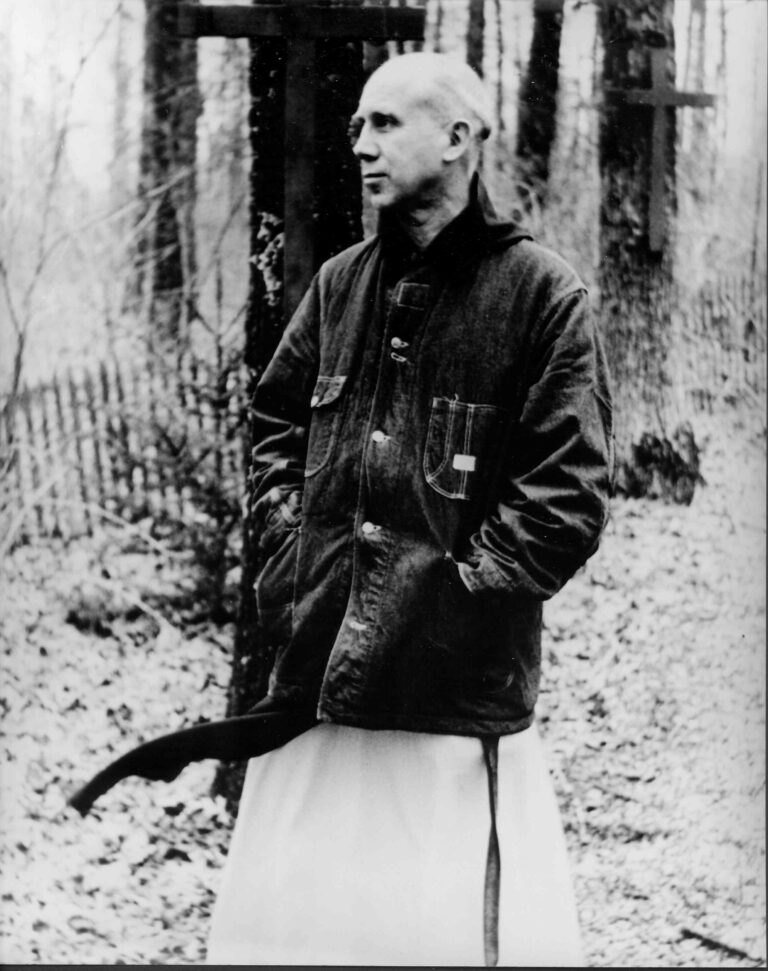
Photograph of Thomas Merton by Miguel Grinberg. Used with permission.
The Thomas Merton Center & The Merton Legacy Trust
We switch subjects and I ask Paul to speak about his work both as the Director of the Thomas Merton Center and as Chief of Research for the Merton Legacy Trust.
“The Merton Center,” Paul explains, “is the official repository of Merton’s literary estate. So, in 1963 he started giving papers to the university here, to Bellarmine. And in 1967 he would make it the official repository so that after his death all of his remaining papers that were at the monastery were transferred here to the university.
“The Center’s primary role really is preserving that material. It is here as an archive, and we also make it available for researchers.”
For Paul, the role of Director has four pillars, the first of which is preservation. This is foundational work without which the Center would not function and includes finding ways to encourage people to access the materials available, which is also a key part of his role as Chief of Research for the Merton Legacy Trust.
The internet has played an increasing role in supporting this, Paul tells me. “It’s opened up what’s here to the world in a way that wasn’t possible before. In the 1990s or before, if you wanted to know: ‘Did Merton correspond with say Henry Miller?’, you’d have to write a letter to the Center.
“Now, someone who’s doing a dissertation on Henry Miller and is maybe Googling something, might suddenly find: ‘Oh yes, he did correspond with Merton,’ and there’s all this information there about their correspondence online. And the same with all the other thousands of people Merton corresponded with.”
Something else that has been fundamental is the knowledge Paul and his assistant at the Center bring to this work. “We’ve read so much of the material, read so much about Merton, talked with researchers, and so we know our way around the material, and we can then help connect the dots for people and point them in other directions. You know: ‘Were you aware that Merton wrote about this subject in some of his notebooks…?’”
Missing pieces – art and anti-racist sentiment
When Paul arrived at the Center, his predecessor had already indexed much of the archive. “However,” Paul explains, “one area that he hadn’t touched was Merton’s artwork. We have over a thousand drawings by Merton; we have photographs by him.”
Paul encouraged a group of researchers to begin to focus on this aspect of Merton’s prolific output, and organised a conference; such encouragement forms the second of Paul’s four pillars.
“You know, two or three people addressing his photography, two or three addressing his drawings. And so we just began exploring that and trying to understand how those materials fitted in with Merton’s writings.”
Another area of Merton’s legacy that Paul felt was very much under-analysed was his writings on racism.
“On the area of social issues, we’ve got probably a hundred theses and dissertations on issues to do with war and peace, the nuclear arms race, and there wasn’t a single one on Merton and racism.”
Paul felt this had been ignored. “And yet,” he explains, “there are two books that certainly address that quite substantially: Seeds of Destruction in 1964 and Faith and Violence in 1968, plus correspondence and other materials.
“Part of Seeds of Destruction is called: Letters to a White Liberal; it accuses white liberals, in much the same way as Martin Luther King did in his Letter from a Birmingham Jail, of controlling the civil rights movement and giving it a certain amount of leeway, but wanting to keep control of it and keep the status quo.
“And Merton was challenging that, and so people have ignored it.”
Paul has been instrumental in bringing Merton’s writings on racism into the spotlight. The Merton Center now holds an annual Black History Month lecture5, and consequently researchers have slowly begun to engage with the material.
“Gradually essays and things have been appearing, and I think there’s now one dissertation on Merton and racism, but there’s still a lot of work to be done on that.”
Paul concludes his explanation of the four pillars of his role within the Center, relating how the third entails promoting Thomas Merton – including within Bellarmine University itself, where students are now taught about the man in introductory talks – and the fourth involves acquiring everything that is published about Merton for the archive in Kentucky.
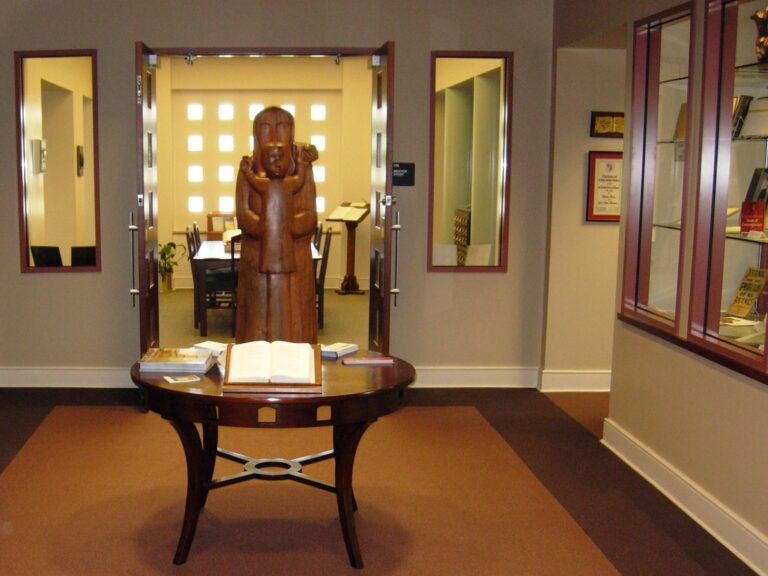
The Thomas Merton Center at Bellarmine University, Louisville, Kentucky.
A favourite Merton passage
Speaking with Paul it becomes obvious that he is indeed the resource he says he is; an undoubted expert in his field.
(He reminds me that my own dissertation on Merton, entitled How did Thomas Merton Understand the Contemplative Life as Leading to a Life of Active Engagement with the World? sits within the collection within the Center’s reading room. I suspect the queue to read that one isn’t too long.)
I ask Paul, does he have any particular favourite passages from Merton’s writings, or texts that he is especially drawn to.
“I think that’s something that develops over time; your reading changes as you get into a figure. I think for many years probably my favourite book was The Sign of Jonas, much more open than The Seven Storey Mountain. But for many of recent years, I think the books that I would point to are probably Conjectures of a Guilty Bystander and Raids on the Unspeakable; writings that come from the late 1950s and early 60s when he was really engaging with the world.
“In a book like Conjectures, it’s based somewhat on his private journals, but with a lot of dialogue that he’s added as he worked on the book, with all the major issues of his day; they’re all in there, and he could have been writing a lot of the stuff today really.
“But also, there’s a mixture in there of his spirituality, his reflections on nature, and central to the book – and I mean central both as in key to the book, but actually almost in the very, very centre of the actual book page-wise – is his experience at Fourth and Walnut.”
An epiphany at Fourth and Walnut
On the 18th of March 1958, Merton had stood at the intersection of Fourth and Walnut (now Muhammad Ali Boulevard) in downtown Louisville, Kentucky, and experienced a personal epiphany. He would later write: “In Louisville, at the corner of Fourth and Walnut, in the center of the shopping district, I was suddenly overwhelmed with the realization that I loved all these people, that they were mine and I theirs, that we could not be alien to one another even though we were total strangers.”
“His famous Louisville epiphany,” Paul explains, “was not a major Damascus Road revelation. I think it was more of an ‘aha!’ moment, that he could just put into perspective his changing perspectives on the world. That this had been going on for a number of years and suddenly he just gets a new insight into it, in a sense.
“But you know, it’s an important one because following on from that his writings do change remarkably.
“Conjectures has that kind of dialogue that I think people need to hear nowadays, and the book is written as almost being a series of reflections; lots of shorter passages. So it’s the type of thing that you can pick up and put down quite easily, which makes it accessible.
“Raids on the Unspeakable is a collection of essays from that same kind of period. It begins with Merton’s reflections on nature and then connects those with what’s going on in the world.
“In Rain and the Rhinoceros (the opening essay of Raids on the Unspeakable) he writes about the guns of Fort Knox, the idea of the rhinoceros being the American military machine, but also this whole thing about totalitarianism that had been on his mind during this period. He’d been reading Hannah Arendt’s accounts of the trials of Eichmann and others, and just seeing what went on within Nazism; how that can come back again and take over a nation and a world.
“With Rain and the Rhinoceros you’re hearing voices that question the understanding of the world, and so Merton points to a 6th-century hermit called Philoxenos, and then the theatre of the absurd with Ionesco’s play Rhinoceros. And so you’re got this creative imagination being able to bring these different things into dialogue, giving this picture of a different way of being in the world. It’s a fairly short essay, but it’s got a really profound and remarkable message.”
Paul relates how Merton’s writings, and in particular Conjectures of a Guilty Bystander, have nourished his own understanding of the importance of loving others even when we might disagree with them. This, he tells me, is much needed in the world today.6
“It’s a remarkable part of Merton that Conjectures was written what: 60 plus years ago, and yet it can speak that profoundly to people in this day and age.”
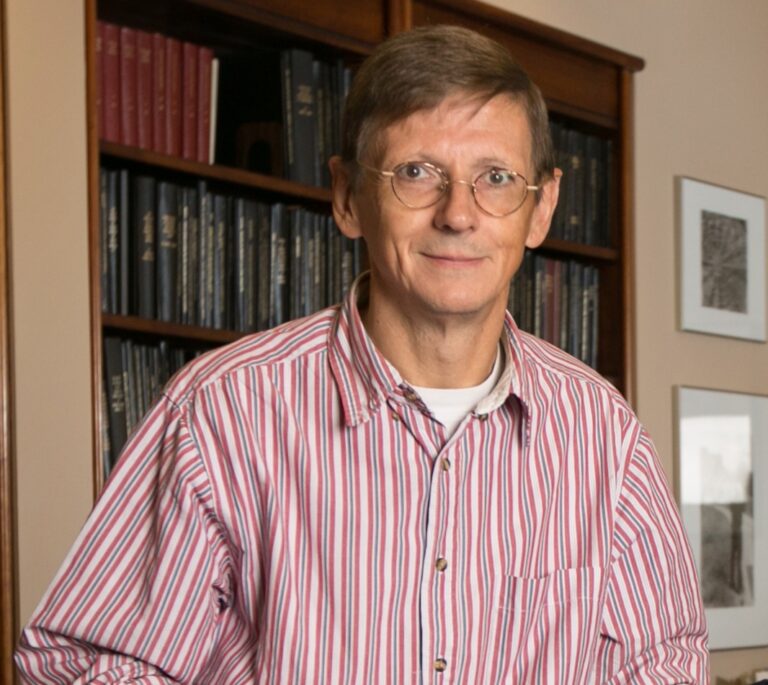
Paul Pearson
Contemplation in a world of action
For my final question I steer us back to the topic of my dissertation: whether one can lead a life of both contemplation and engagement with the world. Two decades earlier, when I first wrote to Paul, I was grappling with this question and seeking answers in Merton’s writings.
I ask Paul how he would describe Merton’s understanding of the relationship between contemplation and action.
“You know,” says Paul, “he probably had an ongoing debate about it and finding the balance. Certainly in The Seven Storey Mountain, you very much get the feeling that he’s turning his back on the world; a world that in many ways has been pretty cruel to him. He’s lost all his family members, his time at Cambridge was a disaster, and so he can just go away and hide in the monastery and pursue his search for God.
“But with his intellect and temperament, that doesn’t remain the case. Through his contact with the students that he’s working with in the monastery, through his reading, you know, I think he finds a different attitude to the world among a lot of the Church Fathers or the mystics that is very different from the Catholicism of his day. And that becomes his model, I think.
“You get this sense of him becoming more and more open to the world. So, in the early 60s, especially in the short period of time before he was silenced about writing on issues of war and peace and the nuclear arms race, he was generating essay after essay on those kinds of issues. Not active, as in ‘out protesting and burning draft cards’, but certainly taking it on board intellectually, and sharing that intellectual journey through his writings.
“Then he becomes a hermit, and so you see this withdrawal more into the monastic life, but I think a large part of that is because the Church has changed during that period.
“Merton was the first Catholic priest to come out against Vietnam, I think, but over the course of the 60s, you get the rise of people like the Berrigan brothers and the growing anti-war movement in the States. You get the Sisters of Selma with enclosed nuns joining in the marches for civil rights.
“Merton’s thinking brought a change there, and the same with say Latin America with the rise of Liberation Theology.
“Ernesto Cardenal, who was quite important in Liberation Theology, was a student of Merton’s at Gethsemani for two years in the mid-1950s and would say that the important things in his life he learned from Merton.
“I think in some ways, Merton probably felt that everything had gone from being too contemplative to too active, and so in a sense he withdrew somewhat and tried to restore the balance again. Nonetheless, he’s still prepared to become more active at times.”
Paul cites Merton’s book Faith and Violence, published in 1968 shortly before his death, as an example of how Merton would continue to respond to the issues of his day, in this case civil rights issues and the burning of draft cards in the USA.
Paul reflects on the sentiments of Canadian Merton scholar Ross Labrie who he recalls saying how Merton had introduced contemplation to the world and the world to the monastery.
“That just seems to get to the heart of it; both sides need what they can bring to each other.”
Or, as one undergraduate once wrote: “Merton understood that the contemplative life led to an engagement with the world. He explained that through a life of contemplation one grew in relationship with God and with His love, a love not only for the individual but also for all humanity. As this love was for everyone in the world, the contemplative was called to engage with others through being in relationship with God.”7
Perhaps the final word should go to Merton, who has been so pivotal in Paul’s life, leading him both on a journey of faith and a vocation. Not quite the one the Irish Christian Brothers had intended, mind; rather one that has deeply nourished him, and enabled him to bring the words of a great Twentieth Century contemplative to a world that needs them. A truly meaningful vocation.
Here then are the words of the wise and humorous Thomas Merton – talking about seeing each other as we truly are – taken from that recording offered by Paul more than 20 years ago:
“You have to leave the rabbits to what they are: rabbits. And if you just see that they’re rabbits, you suddenly see that they’re transparent and that the rabbitness of God is shining through in all these darn rabbits.”8
- Pope Francis addressing a joint session of the United States Congress. ↩︎
- The Thomas Merton Center ↩︎
- Gethsemani Abbey ↩︎
- Thomas Merton and His Holiness the Dalai Lama ↩︎
- The 15th Annual Thomas Merton Black History Month Lecture ↩︎
- “Love, love only, love of our deluded fellow man as he actually is, in his delusion and in his sin: this alone can open the door to truth.” Conjectures of a Guilty Bystander, p. 57. ↩︎
- Tom Blackwell (the author) ↩︎
- Hear Merton’s talk from 1968 ↩︎