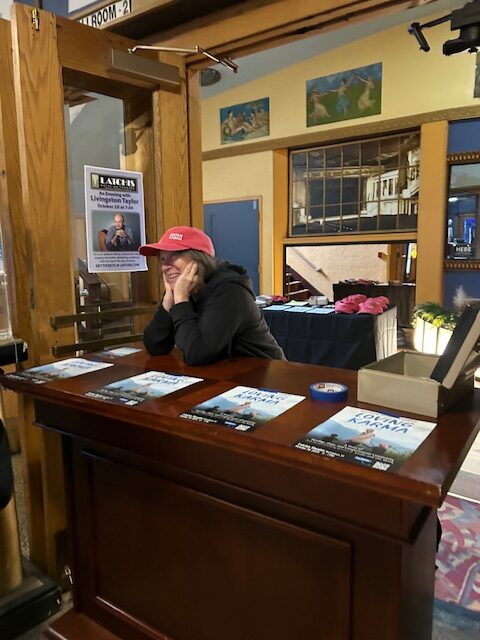
In this, the fourth interview in my ‘Voices’ series, Sandy Crawford reflects on a career in education that has spanned more than four decades and seen her fulfil the roles of teacher, principal and mentor.
Sandy, a determined advocate of bringing social and emotional learning to children and educators today, shares her story of a vocation that has brought her both joy and heartache.
It is a story also of the lessons she has learned along the way that have shaped her inner life and made her the respected friend and mentor she is today, both at Lincoln-Sudbury High School1 in Massachusetts and within Jhamtse Gatsal Children’s Community2 in India.
I am truly thankful to Sandy, not only for making the time for this conversation but for her willingness to share her reflections on her life with such openness and humility.
A Career in Education
Sandy knew from the very beginning that she wanted to become a high school teacher. Inspired by her own experiences of education as an adolescent, and sense of what she could offer, she entered the profession not long out of school herself.
“I think I knew in high school that I wanted to be a high school teacher. I experienced a couple of really great teachers who really cared and really made a difference for me.”
Not everything was perfect nonetheless. “I experienced other things in school where I really felt like: ‘Ah, this could be better’”, Sandy explains.
This thought, that things could be better in education, would set Sandy on a path working with young people in school that continues to this day, first as a teacher, and later as a principal. Today she has transitioned once again, working to promote Emory University’s Social and Emotional Learning (SEL) programme: SEE Learning3, in the school that’s been home to her career.
I ask Sandy, in light of the impact of certain teachers on her own pathway into education: What makes a good teacher?
“I think flexibility, creativity, an openness to learning, a real love of children.
“It’s seeing all beings as worthy of your attention, of seeing people’s potential, of helping them grow from wherever they are. So helping someone grow, and how rewarding that is. I think that those are qualities that I see in really good educators.”
Does the experience of being a teacher differ, I ask, from that of being a principal?
“Very much so. You know, if you’re a good teacher you bend yourself into many different shapes, and contort yourself and work incredibly hard; it’s often true that you can succeed with most students, almost all students.
“Being a principal is really different”, Sandy explains, relating how she was one of four associate principals, each responsible for 400 students in a school with a total of 1600 young people.
“The hardest things came our way. We had all these amazing teachers. If it was possible to deal with something within the structure of the school day and within classes, our incredibly talented teachers dealt with it. And when it couldn’t be dealt with, it landed in the world of administration. I wasn’t always successful there; it’s very humbling.
“Working with adults is really humbling, and hard, and wonderful”, Sandy tells me. “An old boss of mine used to say that every teacher goes into education because they want to work with kids. They don’t want to work with other adults!
“You have this box which is your room, and maybe sometimes it’s a bother that you have to share your room with other adults. But what happens in your box: you’re the boss. You are the person who calls all the shots and makes all the decisions.
“When other adults make different decisions than you, do things in different ways, there’s not always a lot of tolerance. I think there’s also not a lot of understanding of what other people might be doing with kids, even if they’re in the room next door.”
In addition, Sandy explains, rivalries can develop within the teaching body, and between departments, bringing significant challenges. “As hard as teaching is”, she says, “being a principal was harder. But I’m really so happy I did it; it was really humbling.”
The Teacher turned Mentor
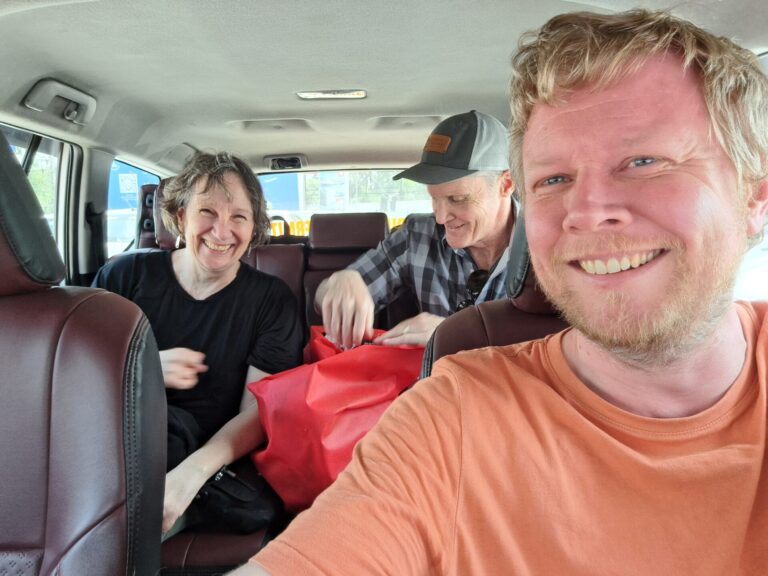
I’ve observed Sandy in the classroom myself, acting not as a teacher, but a mentor. In 2024 I had the pleasure of travelling with her to Jhamtse Gatsal Children’s Community in Arunachal Pradesh, India.
One afternoon we sat in a classroom together, observing an English lesson for a small group of young children. Here, I witnessed Sandy the mentor, perhaps the final transformation in a longstanding career.
On the back of 27 years of teaching, and a further 10 in administration as a principal, Sandy watched the lesson unfold with a quiet reverence. At its conclusion, when the children had left the room, she thanked the teacher for letting her observe, offering some thoughtful words of reflection on the teaching and learning that had just taken place, and smiling warmly throughout.
The path of humility that came to Sandy through being a leader in education is not solely retold through the challenges she faced, it’s a story of transformation: the transformation of teaching experience into practical wisdom worth sharing.
I ask Sandy about her experience of mentoring teachers as a principal.
“I did have some credibility with the teachers. People saw me as a person who could teach a lot of different kinds of students well and might have something to add to the conversation, but I also realised really quite early on that just talking with teachers about what they’re doing is an incredibly profound way to support their work.
“Sometimes we use protocols and really my favorite protocol is three glows and a grow. That before we can talk about something that’s not right, we have to talk about the things that did go well.
“You know, it was never just three, especially with new teachers.” Sandy relates how she’d ask her mentees what was working in their lessons, giving them time to meaningfully explain what they’d been working on, and what they cared about. This helped her to understand.
“I knew a lot of the kids who were struggling with their behaviors or emotions, and I’d often try to go to classes where my struggling learners were so that I could see them in a real context and work with that teacher, and get their insights about what was working and what wasn’t.
“But you know, when you walk into a class, there’s this web of ongoing relationships. If I see a student who happens to just have a normal day, and participated in some group work, I might not know what a triumph that was unless I asked the teacher to tell me what went well.
“I think honoring people’s efforts is important. When people don’t feel seen for their good work, it builds defensiveness and it builds resentment.”
Participating Joyfully in the Sufferings of the World
In 2001, Sandy’s life began to fall apart. A series of challenging experiences led her to an encounter that would not only impact her life significantly, but the lives of many of the children at her school.
“I was 41 years old. I was teaching, and my teaching was going well, but several things were going on.
“My kids were really struggling. My youngest, who we now know is on the autism spectrum, was really emotionally struggling. Big meltdowns, and we couldn’t send her to regular kindergarten. And, her older sister was also socially struggling a little bit, having some issues around math, which is ironic since she is now a middle school math teacher. She was doing two-digit addition by going down one side and up the other, which works okay on addition, but when you hit subtraction, you really have a problem. The teachers couldn’t figure it out, like what the pattern was.
“Then at work, I always had a very close group of friends in my department and we socialized a lot together. One of the people in that friendship group was really struggling, and I tried to help her the best I could, and it wasn’t right, and in the end she decided I was the problem. So I kind of got cut off.”
Life became harder still when on the 11th of September 2001, the day that terrorists attacked the World Trade Center in New York City, Sandy was told by her doctor that a lump was potentially cancerous. “It felt like my world was crumbling, and I realized that despite thinking that I could handle this kind of thing, I really couldn’t.”
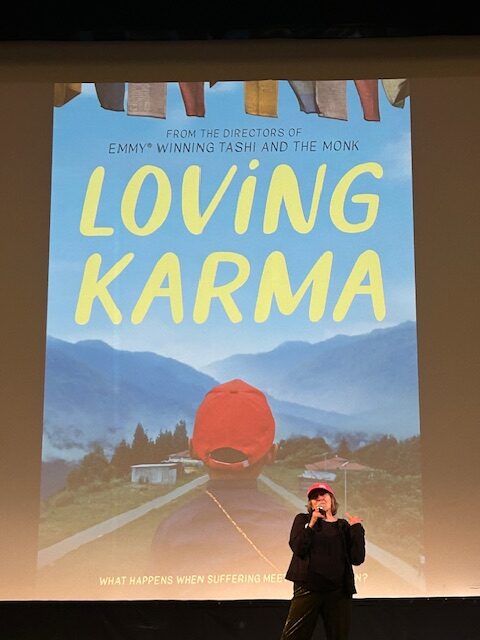
At this time, Lobsang Phuntsok, the Buddhist monk who would later establish Jhamtse Gatsal Children’s Community near Tawang in India, had just begun teaching at the church five minutes from Sandy’s house in Concord, Massachusetts. At the time, Sandy was teaching Asian studies. This, coupled with her longtime interest in Buddhism prompted her to start attending.
She became a regular, and saw the benefit of her practice. “It wasn’t instant, but over the course of years I just found I was much more able to participate joyfully in the sufferings of the world; my own and others.
“I look back at that time now, and I think that those events were my best teachers. You know, my kids were my best teachers, the person who decided I was the problem is my best teacher. But, fundamentally, my best teacher is Lobsang.”
Hurting and Healing
Sandy began attending Lobsang’s talks, but she also saw an opportunity to share his wisdom with the children in her school.
“I used to invite him to teach my Buddhism classes because why wouldn’t I?! And he just became beloved at my school. I already had high enrollments for my classes, but there was a lot of demand because this was the class where the monk comes for a week, and Lobsang was like a rock star. He walked down the hall; my kids would be like: ‘Lobsang, Lobsang!’
“And then, in 2006 when I was actually on leave to get my admin degree, the worst thing happened at my school: a student, who’d had a psychotic breakdown, stabbed another student to death in the bathroom. It was horrible, and the ripples just hit everyone in the community.
“It happened before school, so not a lot of kids were there, but a lot of teachers were. And the teachers were the first responders; the teachers and the administrators and staff were damaged and devastated.
“There was a cascade of trauma with adults, and also kind of with kids; like kids felt unsafe. We were just struggling.
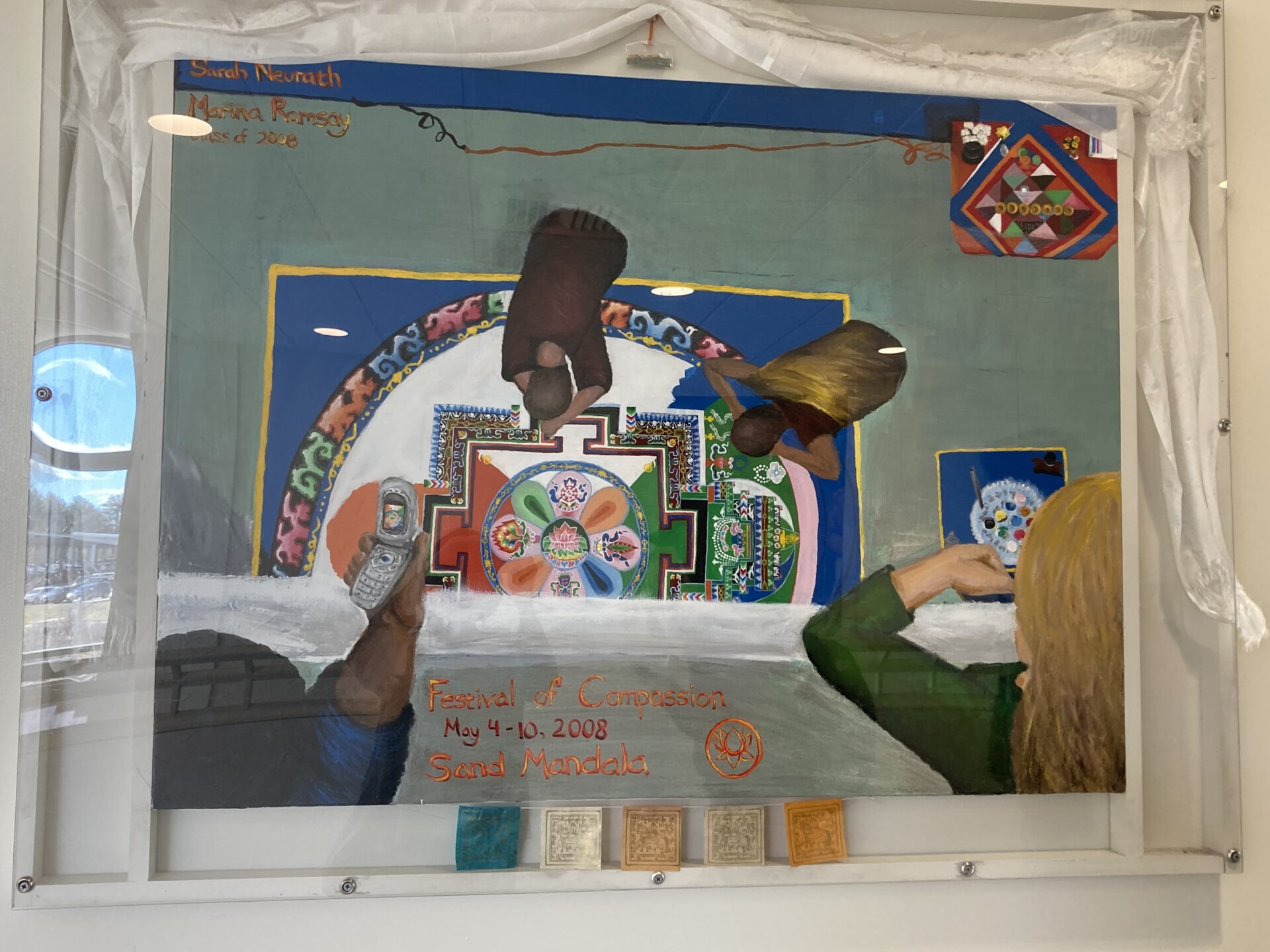
“Then Lobsang had this idea. By then he’d already gone back to India and had the land for Jhamtse Gatsal, and he’d always talked to the kids: ‘Oh, I want to build a garden of love and compassion.’ He returned to the US, and he said: ‘Let’s do a sand mandala.’
“We did a sand mandala right in the middle of the school.4 We invited some monks down from a monastery in northern New York that Lobsang knew, and when it was done it became this celebration that was also a fundraiser for Jhamtse Gatsal.
“Lobsang also did a week of teachings where we just opened up a big room and anyone could come. He would just teach, and over the course of the week as the mandala grew, attendance at his teachings grew.
“And certain teachers just came back again and again and brought their kids again and again. I think it did this powerful thing for us. I think it really helped to heal us; a lot of the adults told me that. I really feel this great debt to Lobsang for that.”
A School at Jhamtse Gatsal
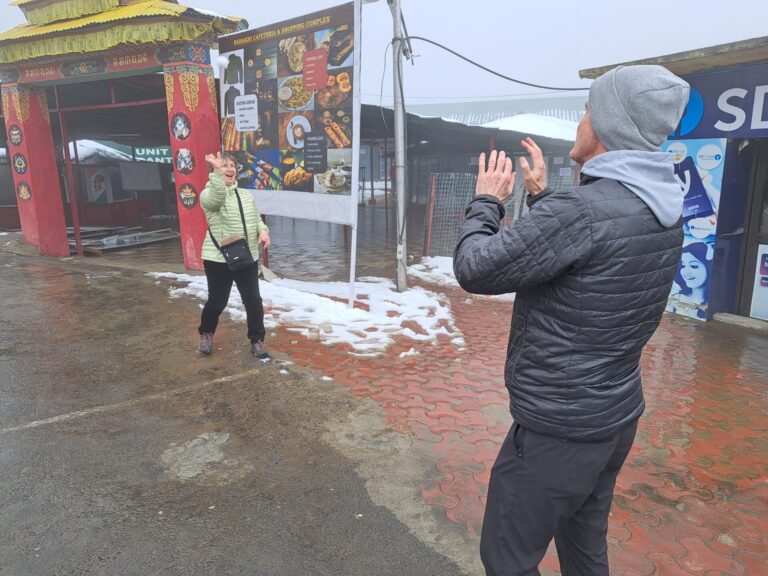
Lobsang returned to India soon after, but the connection remained strong. In 2024, more than two decades on, Sandy visited the Community in Arunachal Pradesh, having supported Lobsang’s work in the meantime to grow the educational offering for the children.
I had been told that it was in fact Sandy who had first encouraged Lobsang to establish a school as part of his vision for what would become Jhamtse Gatsal. I ask her whether this is how it happened.
“You know, I don’t know that I ever thought of it that way; it was just a natural connection.
“What I love about Jhamtse is: Lobsang didn’t go to school, he went to a monastery; the herder community where he was born sent him away to be at the monastery. Here’s a person who never went to school, didn’t have any community, didn’t have any money, and he said: ‘I’m going to start a school for people like me.’
“And he talked about it so compellingly, we all jumped on board.”
I ask Sandy how she would characterise her relationship with Jhamtse Gatsal today, after so much time has passed since her early conversations with Lobsang about creating a school.
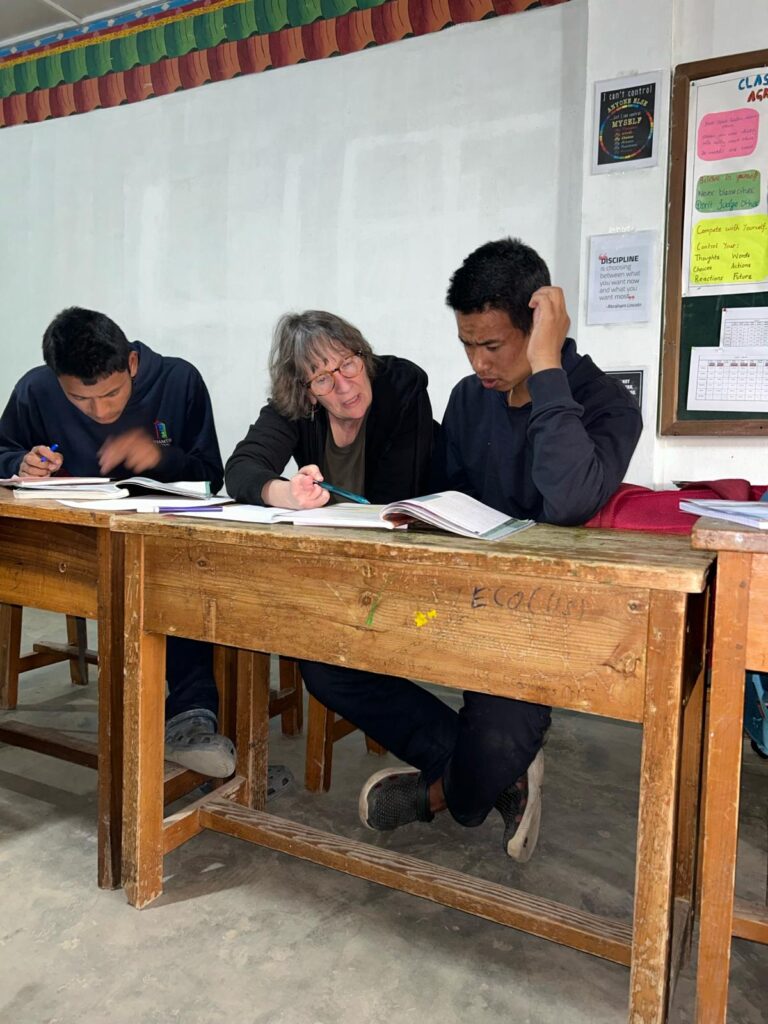
“My biggest takeaway when going there was this: At my school there are things that our kids have access to. There are tools and training that our teachers have access to, that allow for a really rich academic experience for all kids. And that is something that the Jhamtse kids have less so. But, what the Jhamtse kids have that our kids don’t have is: they’re just much happier. It was so striking to me.
“I had these expectations about going to Jhamtse: What would it be like to go to a school where every student was a person who’d experienced trauma? In our school we pride ourselves on having a lot of programs to meet kids’ needs, and we certainly have programs for kids who’ve experienced deep trauma.” Nonetheless, Sandy tells me, when she’s sat in one of those programs in her school in the US, she doesn’t feel that it’s the Jhamtse children that are the ones struggling.
“That really struck me, and that kind of just led to my last year of work: I’ve been working with the Principal, and Tenzin the Headteacher, and we’ve been doing work bringing universal design for learning to Jhamtse and to help share with teachers some of the techniques that they haven’t been taught.
“Then, what I’ve been trying to bring back to my school is: Jhamtse teaches happiness, compassion, self-awareness, like we teach math. Every day. And they practice. If we taught math the way we teach happiness, emotional self-regulation, caring for others, understanding ourselves, kids would not know math. You can’t just do it in an assembly a couple of times a year!
“So that’s what I’ve been working to bring back to my school. I ran a group exploring SEE Learning for teachers last year. We just met monthly and did some of the training – some of the activities that we would do with kids – with each other.
“One of our goals this year is that we’re really going to try to lean in more on staff well-being. Our teachers are universally wonderful to kids, and really hard on themselves; really hard on each other. Of course, everyone hates admin. The well is dry, right? And when the well runs dry you take every last drop for kids because that’s why you’re there, and you don’t have a lot of capacity for yourself or for other adults. That’s the task, I think.”
Reflections on the Journey
I recall someone once saying, humorously, that becoming a monastic was one route to Enlightenment, though becoming a parent was a faster one! Sandy’s journey on the path of introspection and self-development has seen her not only become a parent, but take on a heartfelt responsibility for students both at home in the United States, and in India. In a career spanning over 4 decades, she has seen countless children and young people pass through her classroom and her care, so I ask her, with my final question: How have you changed throughout this journey?
“I think I am much more accepting of other people and myself now. I think I would have said in the past that I was tolerant and open, but scratch the surface and I don’t think so!
“It’s really opened me to growth. Growth mindset has been a big titter-tatter in educational circles for the last 30 years, ever since Carol Dweck started talking about mindset; but cultivating a growth mindset is hard. You really have to be able to see yourself as a person with strengths and vulnerabilities and weaknesses, someone who does good things and makes mistakes and sometimes does their best and sometimes doesn’t, like being able to accept that whole package, and then you sort of move ahead.
“Recognizing our strengths and then saying: Well, I really want this thing; it’s not something I’m good at right now. How can I make progress towards achieving this? And celebrating the small steps, recognizing that sometimes you step backwards, right? But continuing this journey with integrity and love for yourself and respect for others, that’s a really hard thing to do. I think this journey has helped me be able to do that.
“Not unerringly. Do I sometimes get annoyed at myself? Do I sometimes get annoyed at other people? Yeah, I’m a human being! But in the end, being able to sort of embrace the whole process, I think that is kind of the gift of Jhamtse. And I will say, Jhamtse is not perfect, Lobsang is not perfect. And that’s okay. It’s really okay.”